Small-allowance eSIMs: when 500 MB is genuinely enough
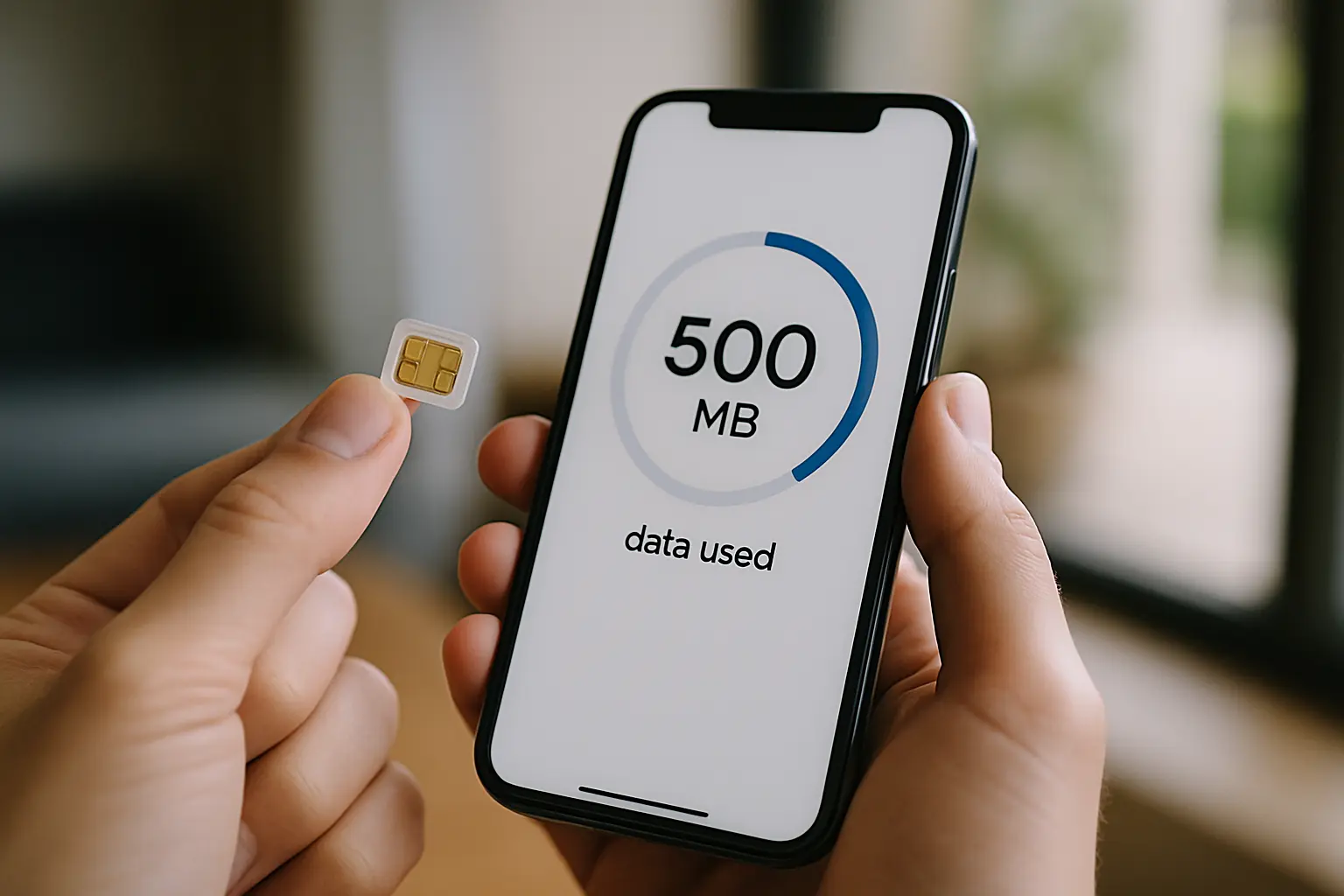
Small-Allowance eSIMs: When 500 MB Is Actually Enough for Your Trip
Most eSIM guides push you toward multi-gigabyte plans, but the reality is that a small allowance often works perfectly if you know what you're doing. This guide helps you figure out whether 500 MB—or even 100 MB—makes sense for your Japan trip, and which providers offer genuinely usable micro-plans.
How Much Data Do You Actually Need?
The answer depends entirely on what you're using your phone for. This is worth thinking through before you buy, because the difference between a $0.31 plan and a $16.50 one comes down to your actual behavior, not marketing.
For navigation and messaging: You barely need anything. Google Maps uses roughly 0.3–0.5 MB per hour of navigation. WhatsApp and iMessage are negligible. Email, over a reliable connection, might be 0.1 MB per message. If your main concern is staying in touch and not getting lost, 100 MB gives you genuine runway—enough for 100–200 hours of map use, or thousands of messages. For a typical week-long trip where you preload maps and use data only for directions between known locations, 500 MB is comfortably more than you need.
For video, social media, or streaming: You will burn through any small plan in hours. YouTube at standard quality uses roughly 5–10 MB per minute. Instagram and TikTok, if you're scrolling actively, consume 1–3 MB per minute. If this is your use case, a 500 MB plan lasts maybe an hour of leisure browsing and is not for you.
For occasional browsing and app updates: This is the middle ground. Light browsing—checking weather, news, restaurant reviews—uses 0.5–2 MB per page. A typical app update is 20–200 MB. If you're planning to download apps or update during your trip, you'll want more than 500 MB; if you're happy with what's already on your phone, you're fine.
The key is honesty: what will you actually do without WiFi access? Most Japan travelers stay in hotels or hostels with WiFi, eat in places with WiFi, and use it at airports and stations. If you fall into that group, 500 MB for navigation and messaging between WiFi stops is not a tight fit—it's a genuinely rational choice.
The Smallest Plans Available for Japan
Several providers now offer plans in the 100–500 MB range, priced for travelers who don't want to pay for data they won't use. Here's what's available.
Ultra-budget entry points: Horizon eSIM sells 100 MB for 7 days at $0.31 for Japan, making it the cheapest confirmed option in this size range. Simsima offers 100 MB over the same period at $0.40. If you need slightly more headroom, AlpineSIM's 500 MB plan costs $0.56 over 7 days—a meaningful step up in allowance for minimal extra cost. Voyasim also offers 500 MB for $0.50 over 7 days.
Free options with a catch: GigSky advertises 100 MB over 7 days for Japan at $0.00, and Roamless offers a 525 MB plan with no expiry date, also at $0.00 for new users. These are worth investigating if you're new to either provider, though you should verify current availability and any terms that might apply to free tiers before relying on them for a trip.
Where larger plans start: Airalo's smallest paid Japan eSIM plan is 1 GB over 3 days at $4.00. This is a sharp price jump from the micro-plans, but it reflects the different use case: Airalo's plans assume active data use, not just emergency navigation and messaging.
The cost difference is worth visualizing. Horizon's 100 MB plan at $0.31 costs roughly one sixtieth of Airalo's 1 GB plan at $4.00, yet covers roughly the same time period (7 days versus 3 days). If you're genuinely confident you'll only use data for maps, messaging, and light browsing, that $0.31 option is not a gimmick—it's a rational fit.
Pricing snapshot: These figures were gathered on 2026-08-01. eSIM pricing changes regularly and varies by provider, region, and duration. Confirm current pricing before purchasing.
Who Should Buy a Micro-Plan, and Who Shouldn't
A 500 MB plan makes sense if:
- Your trip is 7 days or shorter and you have WiFi access at accommodations and most meals
- You're using data mainly for offline-first navigation (loaded maps via Google Maps or similar) and messaging apps
- You want a safety net for directions without paying for data you won't use
- You're comfortable managing data use and monitoring your balance
A 500 MB plan is the wrong choice if:
- You plan to stream video, music, or podcasts without WiFi
- You use social media actively or browse heavily for leisure
- You're not sure when or how much you'll use data—you need the mental peace of a larger allowance
- You plan to download or update apps during your trip
- You want to avoid the friction of watching your data balance carefully
Practical Tips for Making a Micro-Plan Work
If 500 MB appeals to you, a few habits will make the difference between comfort and running dry.
Preload maps using Google Maps, Apple Maps, or similar before you leave your accommodation. Download the areas you'll visit for that day. Offline maps use no data, work perfectly, and let you navigate without the live-update overhead.
Use WiFi-first messaging. WhatsApp, Messenger, Telegram, and iMessage all work over WiFi. If you have access to WiFi at your hotel or a café, that's where you send longer messages and check emails. Reserve your data for navigation and quick checks when you're out.
Turn off background app refresh and automatic updates. These quietly drain your allowance. Do any necessary app updates on WiFi before you leave.
Keep airplane mode on except when you actively need data. This prevents your phone from hunting for signal or refreshing in the background.
The Real Trade-Off: Flexibility Versus Savings
The honest frame: a $0.31 eSIM saves you money by assuming you know exactly how you'll use data, and that assumption is often right. But it also means you have zero buffer for the unexpected—the sudden need to video call home, the urge to upload photos, the app that needs updating. Airalo's $4.00 1 GB plan removes that tension at a measurable cost.
Neither choice is objectively correct. The question is whether you trust your own discipline and your access to WiFi. For a short trip in urban Japan, where WiFi is abundant and your data use is genuinely limited to navigation, 500 MB is not a compromise—it's the sensible choice.